
Fiddling the Figures (?) While Moscow Burns
Russian President Vladimir Putin has long been adept at avoiding bad news, but current events are stretching that

The Russian regime has a default mode for dealing with crises: ignore them. This ensures officials or state media avoid amplifying problems and can help deflect attention to other, less worrying issues.
This has been the approach with the fuel crisis, with Putin and other officials resolutely silent on the matter.
This only works so far; if the crisis intensifies, there is a (small) range of other techniques that the regime and its informational resources can deploy to diffuse the problem. These efforts can take the form of complex information operations, working in different ways to target different audiences. Blaming foreign agents is a common ploy. The regime’s efforts are supported by, and exacerbate, the country’s atomised society and media environments. The state will often go all out to claim that it is confronting the crisis, it will bring out supposed evidence to claim that it is managing the problem, it will find people to insist that the authorities have helped them.
One person absent in the management of problems—until they are resolved—is Putin. The regime generally does all it can to disassociate Putin from problems, be they the Kursk submarine disaster, terrorist attacks, the Prigozhin mutiny… The list goes on, and there is actually some useful material on his disappearing acts.
The authorities have been loathe to discuss the fuel crisis, and pro-Kremlin hacks had gone out of their way to try to deny any such problems exist, until they could no longer get away with this.
State news has confronted the issue this evening, but unsurprisingly tagged it on to Vice Prime Minister Aleksandr Novak, who insisted that the fuel situation was now stabilising ‘thanks to Government measures’ (banning some exports, importing more, and increasing refinery output). You would not see Putin getting his hands dirty with such work, though it is possible that he will try to take the credit if things do improve.
The administration of the economy is traditionally a governmental, not presidential, matter, though Putin does enjoy being associated with supposed economic successes. He received today, supposedly, Maria Kostyuk, Governor of the Jewish Autonomous Region that borders with China in the Far East.
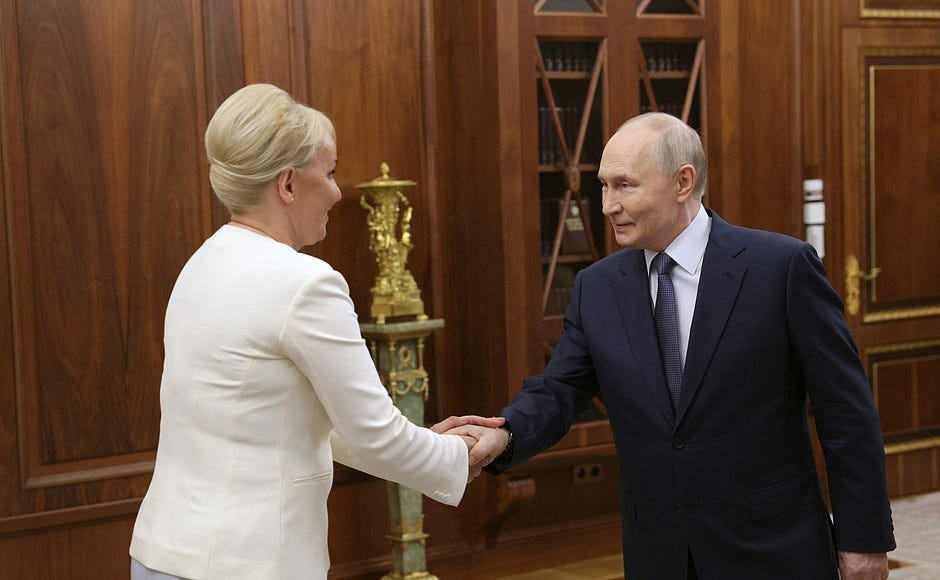
Kostyuk told Putin that the Jewish Autonomous Region’s gross regional product had risen by 4.4 percent, and fixed capital investment had risen by 35 percent (largely from projects involving China). I have not had chance to check these figures and whether they are genuine, but they are remarkable in the context of the severe financial problems hitting many regions.
We still know very little about how regional authorities manage their information flows to the centre, and we need more work on this area.
Putin, of course, now gets his briefings (or at least the ones we see on television) in massive A3 pamphlets with enlarged scripts and diagrams (his interlocutors get the same, less his possible deteriorating eyesight becomes more visible).
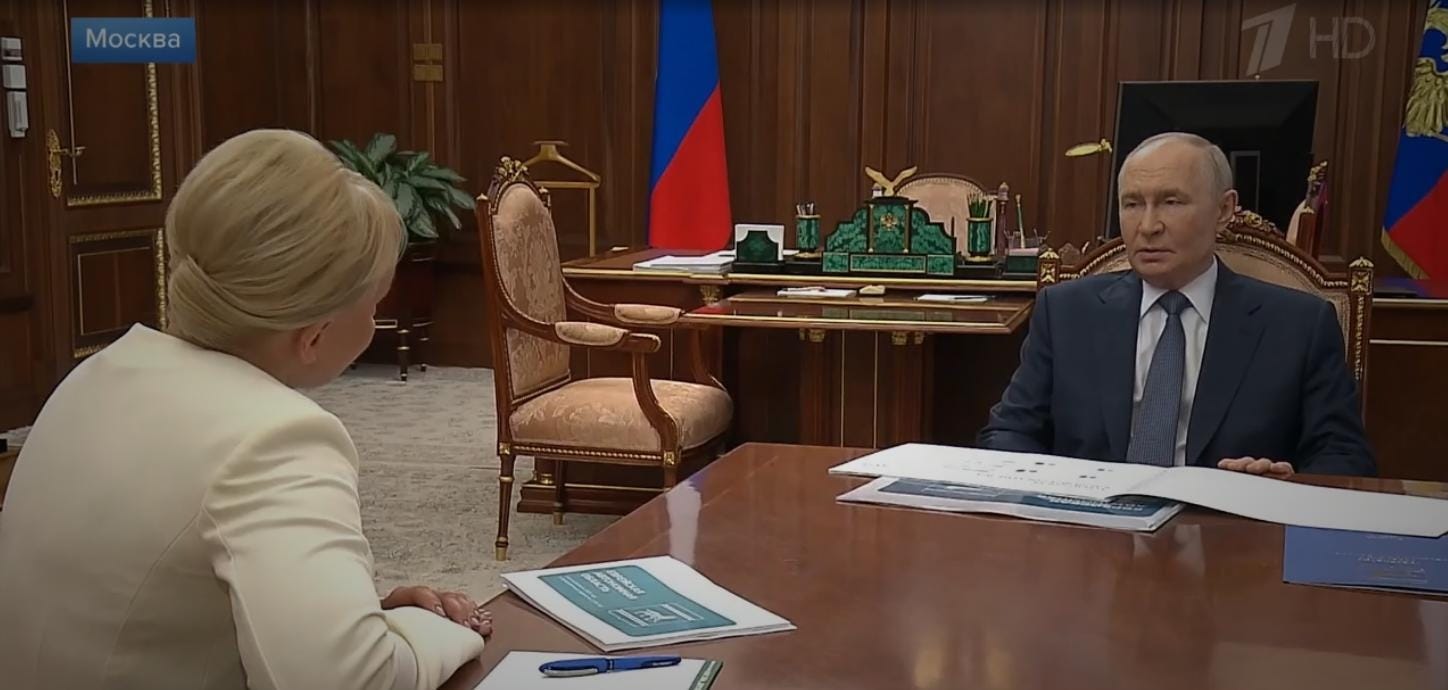
The Kremlin website provided a short report on the meeting that focused on alleged economic pluses. The segment on Channel One was longer, however, and discussed Kremlin support for fighters in the war on Ukraine, though it was also horrifically personal. Kostyuk’s son signed up to fight in Ukraine and died there, though Kostyuk spoke to Putin about him with bizarre pride and enthusiasm, as well as about the opening of a new memorial in the region to the mothers of ‘heroes’.
‘An excellent idea,’ Putin replied.
All these relationships in Russia are being rewritten, possibly for television viewing, but in the most grotesque way. Vertical relations are being imposed, but between the leader and the regions, the people. Perhaps it is easier to fiddle human relations than economic figures. These are replacing the older, real vertical relations of the family. A new version of the patriarchal state, but perverse, with no sign of an end. And it is getting harder for the Russians to ignore or evade.