
They Told You So
Don't tell me I didn't warn you: a short note on that Tulsi Gabbard announcement

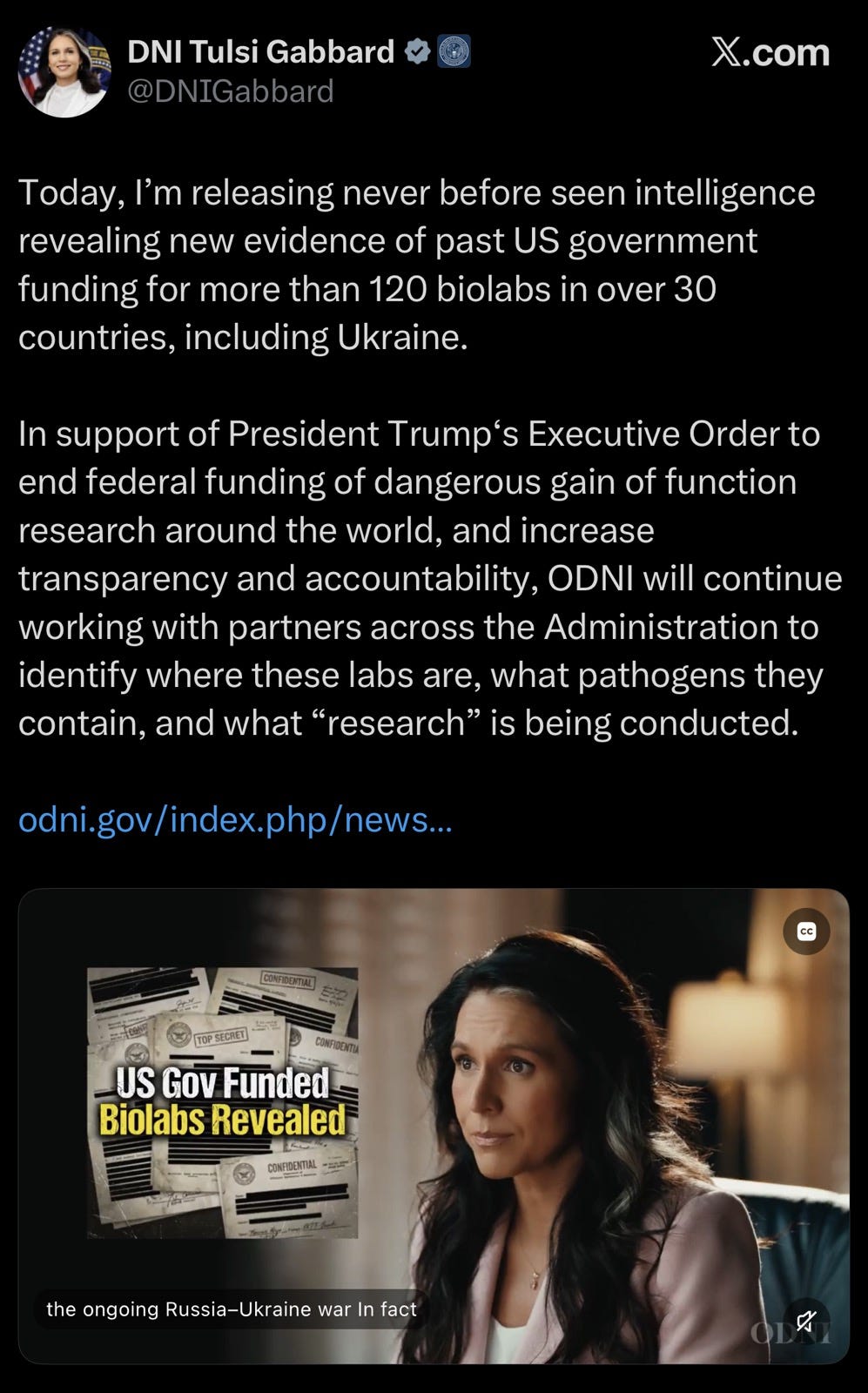
Outgoing National Intelligence Director Tulsi Gabbard has claimed on Friday 11 June that the US Government has funded over 120 ‘biolabs’ across 30 countries, adding that the intelligence community had already noted warned that a US-funded ‘biolab’ in Ukraine likely held dangerous materials.
I was staggered to see her claims, even though I studying modern Russian information manipulation has been my career for 26 years, almost to the day when Vladimir Putin invented the discipline (I was one of the, if not the, first to do this type of thing, back in 1999).
Little should surprise us, but more professionally we should be more prepared to counter a more complex and growing range of cognitive threats.
Methodologically, we must be more prepared to understand the theoretical and operational convergence (globalisation) of Russian information manipulation with other countries’ efforts, especially with the Americans. Note that Gabbard uses classic Russian techniques in her messaging.
I have argued previously that we need much better understanding of the interconnectedness of information manipulation, how foreign threats pass into and through domestic ecosystems. We need new laws and compliance approaches from domestic governments to allow proper investigations into such operations. We also need much better cultural understanding into and responsibility for domestic vulnerabilities.
More acutely: I have recently argued that Moscow will likely reassess its approach to information manipulation in the wake of its military’s failures to achieve many of its objectives. We need to understand that information manipulation is a core offensive approach for the Russians, not an appendage to kinetic activity. Information manipulation is a form of war for them, and they are almost certainly reassessing the balance and relationship between military offensiveness and informational offensiveness. We need to step up and take that seriously.
We are highly likely seeing, as I predicted, a expansion and intensification of Russian information manipulation, in response to those military failures. This expansion is likely to take new but also old forms, reviving ‘biolab’ conspiracy theories from years ago, dragging people like the Tates to Russia to help push Russia’s messaging at target audiences around the world. I did tell you.
I did not tell you this, as I am only thinking more: the Russians are desperate for American assistance in the war on Europe. It might be far more convenient for Moscow to lean on certain Americans to help in the informational sphere. We should watch for this growing convergence of Russian-American messaging and prepare accordingly. Gabbard is leaving, but she almost certainly will not be the last.